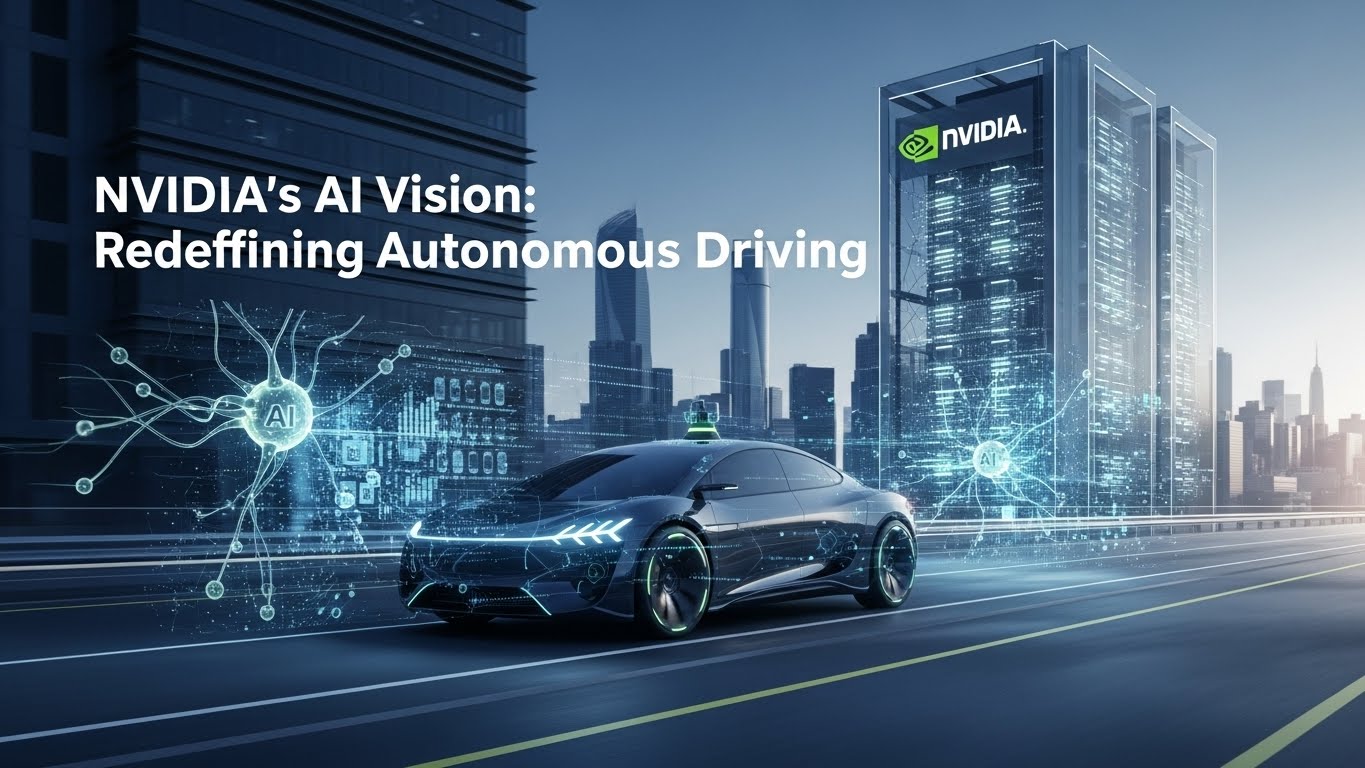
NVIDIA Redraws the Map: From Hardware Giant to the Foundation of Global AI and the Future of Autonomous Driving
The global technology industry is entering one of the most profound transformation cycles in decades. At the center of this shift stands NVIDIA, no longer positioning itself merely as a graphics chip powerhouse, but as a company determined to become the foundational infrastructure of global artificial intelligence, including the brain behind next-generation autonomous vehicles.
In its latest presentation, NVIDIA CEO Jensen Huang described the current moment as a rare convergence in computing history, with two platform shifts happening simultaneously. First, AI is evolving from a supporting feature into the core platform itself. Second, the entire computing stack, from silicon and systems to software and networking, is being reinvented specifically for AI.
For NVIDIA, this shift is not just technological. It represents a multi-trillion-dollar business realignment.
AI Is No Longer an Application Layer. It Is the Platform
For years, AI quietly operated behind the scenes through recommendation engines, image recognition, and algorithmic optimization. NVIDIA argues that era is over. Today, applications are built on top of AI, not the other way around.
Large language models, agentic AI systems, and physical AI now form the foundation of modern software development. Applications are no longer strictly programmed. They are trained, reasoned, and continuously adapted to real-world contexts.
This paradigm shift is reshaping enterprise budgets worldwide. Research and development spending is being redirected toward AI, while legacy computing infrastructure, estimated by NVIDIA to represent nearly 10 trillion dollars in value over the past decade, is undergoing forced modernization.
Open Models as a Strategic Business Weapon
While much of the AI race is becoming increasingly closed, NVIDIA is taking a contrasting approach by building frontier AI models in the open.
By open-sourcing models, training data, and AI development libraries, NVIDIA enables companies, governments, and startups worldwide to build on its technology stack. This strategy effectively positions NVIDIA as a global AI standard, even without directly controlling downstream applications.
This open approach already spans multiple industries, including digital biology, climate modeling, robotics, manufacturing, and enterprise AI. One domain, however, stands out as both technologically complex and commercially significant: autonomous driving.
Why Traditional Autonomous Driving Systems Are Reaching Their Limits
Autonomous driving is not new. Advanced driver assistance systems, autopilot features, and partial self-driving capabilities are already available in consumer vehicles. However, NVIDIA believes most existing systems share a fundamental limitation. They are largely reactive and rule-based.
Traditional approaches typically depend on predefined scenarios, require massive amounts of real-world driving data, and struggle with rare or unpredictable long-tail driving events.
The real world is inherently chaotic. Not every dangerous or unusual scenario can be captured through real-world data collection alone.
Physical AI: Teaching Machines to Understand Reality
NVIDIA’s answer is Physical AI, AI systems designed to understand the laws of physics and the causal structure of the real world.
Rather than simply detecting objects, physical AI comprehends object permanence, speed and distance, momentum, friction, gravity, inertia, and unpredictable human behavior.
This allows autonomous vehicles to reason about situations, not merely respond to sensor input.
To train such systems, NVIDIA relies heavily on physics-based simulation through its Omniverse platform and the Cosmos world foundation model. These tools enable the generation of millions of physically accurate synthetic driving scenarios, ranging from extreme weather to rare accident cases, without real-world risk.
Reasoning Autonomous Drivers: A Step Beyond Conventional Autopilot
One of NVIDIA’s most notable breakthroughs is the introduction of a reasoning-based autonomous vehicle AI, trained end-to-end from camera input to vehicle control.
Unlike traditional systems, this AI can explain why it chooses a specific maneuver, decompose complex traffic scenarios into understandable components, and handle one-shot situations it has never encountered before.
This reasoning capability directly addresses the long-tail problem, which includes situations that are too rare or dangerous to collect at scale in real-world driving.
Can NVIDIA’s Approach Surpass Existing Autonomous Driving Systems?
From a technological standpoint, NVIDIA’s architecture has the potential to outperform many current autonomous driving solutions over the medium to long term.
While existing systems excel in structured and predictable environments, NVIDIA’s approach is designed for context-aware decision making, higher resilience in edge cases, and faster global scalability through simulation-trained intelligence.
Commercial adoption will still depend on regulatory frameworks, safety validation, and public trust. Importantly, NVIDIA does not aim to manufacture vehicles itself. Instead, it seeks to become the cognitive platform powering autonomous mobility.
Vera Rubin: The Supercomputer Built for Thinking AI
Such ambitions require unprecedented computational power. NVIDIA addresses this with the Vera Rubin AI Supercomputer, a next-generation system engineered for the explosive growth of AI computation.
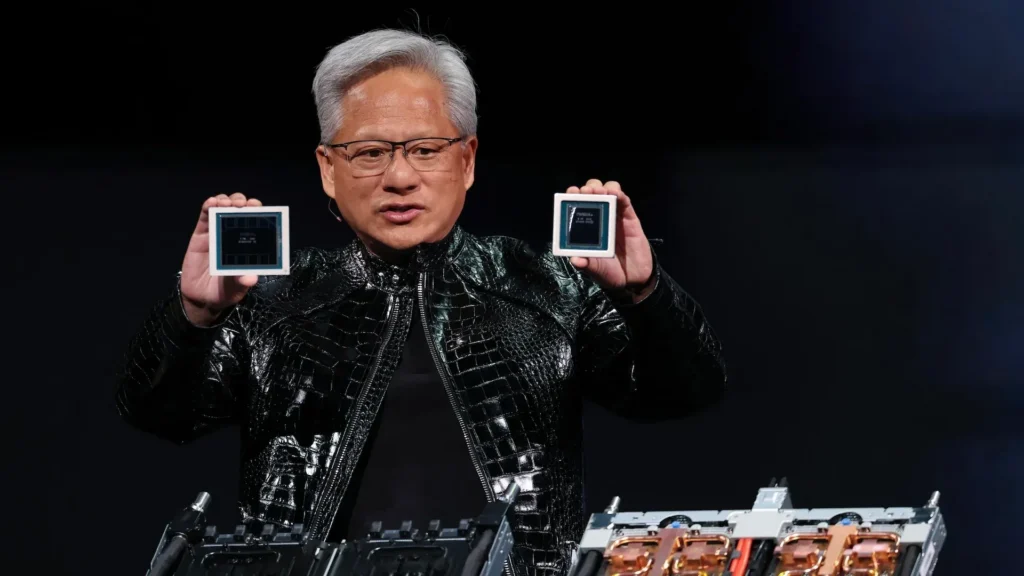
Delivering up to 100 petaFLOPS of AI performance, Vera Rubin emphasizes not just raw power but energy efficiency, security, and tightly integrated chip design. It is built to support AI systems that must reason, simulate, and plan in real time.
For autonomous driving, this translates into faster training cycles, deeper simulations, and safer deployment pipelines.
NVIDIA’s Business Strategy: Owning the Stack to Shape the Future
From a business perspective, NVIDIA’s direction is clear. The company aims to control the entire AI stack, from silicon and networking to simulation, software, and models.
In the automotive sector, this strategy is especially powerful. NVIDIA does not need to compete with car manufacturers. By supplying the intelligence behind autonomous systems, it secures a position that is difficult to replace and capable of generating long-term, recurring revenue.
Toward Vehicles That Truly Understand the World
If NVIDIA’s vision materializes, the future of autonomous driving will not be defined solely by sensors and algorithms. It will be shaped by AI systems that understand the physical world in human-like ways.
The question is no longer whether NVIDIA is just a hardware company. That debate is settled. The real question is how much influence NVIDIA will have in defining the future of AI-driven mobility and global computing.
One thing is clear. NVIDIA is not merely participating in the AI race. It is building the track.